This isn't to mention that there are no text linked to the Serbian, Bulgarian, and even Russian regular languages in the language, but fairly that they were discouraged on the principle of "looking for indigenous product very first".[ninety six]
These languages generally have e absolutely free word buy and are SVO languages.The subject in Balkan language may very well be pre verbal or publish verbal. A different linguistic phenomenon while in the Balkan languages is the professional- Drop or Null Subject matter. Balkan languages outcome as Professional- drop languages: they allow a Null issue within just their clauses. Beside this, the professional topic is achievable in the subordinate clauses also. We now have analyzed in a Generative check out this phenomenon, dependant on current linguistic scientific studies. We discovered that it's the verb Settlement, with its functions [+T,+AGR] which licenses the pro subject matter. During this framework we have analyzed not only the clauses of some Balkan languages, but additionally their sentences. We discovered that not every one of the Null topics with the subordinate clauses are Professional-dropt. Some languages like Albanian and Italian Use a Null Matter within their clauses, since equally of them Have a very abundant inflectional verbal technique. We're going to check out What's going on Along with the Balkan languages, if they have got or not Null Topics in their sentences. Important phrases: Sprachbund, Balkan languages, topic, structure, Professional- Drop, Null Topic.
[119] The identical yr Bulgaria revoked its recognition of Macedonian nationhood and language and implicitly resumed its prewar place of their non-existence.[a hundred and twenty] In 1999 The federal government in Sofia signed a Joint Declaration from the official languages of the two nations around the world, marking The 1st time it agreed to indicator a bilateral agreement created in Macedonian.[121] Dialect experts of your Bulgarian language confer with the Macedonian language as македонска езикова норма (Macedonian linguistic norm) on the Bulgarian language.[10] As of 2019, disputes concerning the language and its origins are ongoing in educational and political circles in the two nations around the world.
Qualitative strategies in method of elicitation had been utilized. The results indicated signs of semantic bleaching and obtaining qualities of a particle in the use of the Kurdish phrase and gave justification for just a potential analysis concerning the etymology of your particles on Balkans.
An important theoretical problem is elevated pertaining to the potential for discriminating, by way of strictly linguistic strategies, the outcomes of language Get in touch with from developments affected by inside variables. This contains progressive changes during the stock and distribution guidelines of phonemes, grammatical models (markers), groups, lexical, and phraseological composition in the language. The potential role of Call in preserving archaisms in language structure is likewise regarded.
It focuses on the ways that this Resourceful usage of language by speakers through the periphery on the Serbian linguistic-cultural Place repositions the now established ideological frames of urban–rural and native–national–global, and so destabilizes the ideologically mounted connection between the linguistic centre as well as periphery.
e. it is actually added like a suffix to nouns. Somebody feature in the Macedonian language is the usage of 3 definite article content, inflected for gender and linked to the situation of the thing, which may be unspecified, proximate or distal.
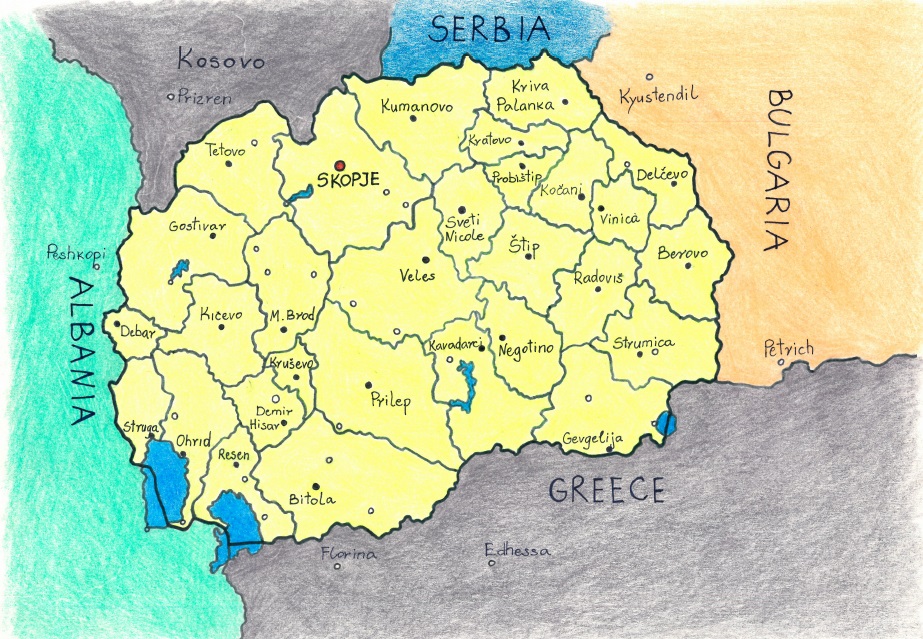
7 million folks, it serves as the Formal language of North Macedonia.[five] Most speakers are available from the place and its diaspora, with a smaller variety of speakers all through the transnational area of Macedonia. Macedonian can be a regarded minority language in aspects of Albania, Bosnia and Herzegovina, Romania, and Serbia and it is spoken by expatriate communities predominantly in Australia, Canada, and the United States.
Zuvor waren mazedonische Varietäten in den 1930er und der ersten Hälfte der 1940er Jahre mit individuellen Adaptationen der serbischen oder bulgarischen Kyrilliza geschrieben worden.[31] Kyrillisch
This article analyses, throughout the framework of cognitive linguistics, using some Drinking water metaphors inside the phraseology of three Balkan languages, Albanian, Macedonian and Fashionable Greek. H2o, which occupies a major area in human expertise and perception, presents a flexible framework for metaphorical expression in various components of human lifetime. In phraseology, these metaphors are prone to play an important position in conveying abstract principles and cultural Strategies rooted inside the encounter of h2o and its a variety of manifestations within the a few Balkan languages.
Krste Petkov Misirkov's e-book Za makedonckite raboti (On Macedonian Issues) revealed in 1903, was the initial make an effort to formalize a independent literary language.[forty five] Using the reserve, the author proposed a Macedonian grammar and expressed the target of codifying the language and utilizing it in universities. The author postulated the theory the Prilep-Bitola dialect be used being a Sprachentwicklung im Balkanraum dialectal foundation for the formation on the Macedonian standard language; his thought having said that was not adopted right up until the 1940s.
One of the more characteristic features with the Balkan Sprachbund is the way in which wherein idiomatic phrases cross from 1 language to another with this sort of clear simplicity, and just how during which they offer such a Balkan "fl avor" to every person language. The gathering and analysis of these kinds of instances is undoubtedly an ongoing, and important, contribution to our comprehension of Balkan society and also the homo balcanicus. The main focus of these types of contrastive phraseology scientific studies is generally semantic. In contrast, my target here is the phrase to be a grammatical construct, defi ned roughly to be a "grammatically signifi cant group of tokens, the that means of which it is actually not possible to tag at the level of the person token". My illustrations are taken from Slavic (primarily Bulgarian), but mainly because many signify wellknown morphosyntactic "Balkanisms", the discussion frame is broader. Not all these types of phrases are specifi cally Balkan. Refl exive verbs, As an illustration, which include a key verb type as well as a refl exive particle (like разбира се 'it truly is understood') are located in non-Balkan South Slavic also.
This paper offers three forms of expressions designed via the semantic adjust, that happen to be most frequently recorded within the Slovenian! Linguistic! Atlas. These are definitely metonymic, metaphorical and hyperbolic expressions. The final A part of the paper emphasises the queries of unusual presumably metonymic expressions where by it is unclear whether or not they absolutely are a results of a semantic transform, or an mistake.
Scientific tests in linguistics is often a recently Started international, open up-entry, peer-reviewed journal that focuses on the modern Slavic and Balkan languages within the standpoint of theoretical, areal-typological, and contrastive linguistics. The Journal intends to advertise large-high quality scholarly Focus on all matters related to the theoretical description and Assessment of Slavic and Balkan languages in synchrony in addition to in diachrony. The primary parts of fascination consist of, but are not restricted to, their structural make-up, Make contact with in space and time, variation and microvariation during the Balkan-Slavic spot, initial and next language acquisition in bilingual and multilingual environments.
Correct nouns are for each definition definite and are not normally applied along with an report, Despite the fact that exceptions exist from the spoken and literary language for example Совчето, Марето, Надето to exhibit emotions of endearment to anyone.
And still, tourism and also the arrival of recent populations have Sprache in Mazedonien substantial and lasting consequences around the LL which often can only be adequately investigated by systematic ethnographic research in the semiotic usually means employed in inscribing it.
Welche Sprache spricht man in Mazedonien?
Viele Menschen stellen sich die Frage: Welche Sprache spricht man in Mazedonien? Die offizielle und am weitesten verbreitete Sprache ist Mazedonisch. Sie wird von der Mehrheit der Bevölkerung als Muttersprache gesprochen und dient als Amtssprache in Verwaltung, Politik, Bildung und Medien. Im alltäglichen Leben ist Mazedonisch allgegenwärtig und verbindet Menschen unterschiedlicher Generationen.
Neben der mazedonischen Sprache existieren jedoch weitere Sprachen, die von ethnischen Minderheiten gesprochen werden. Besonders Albanisch nimmt eine bedeutende Stellung ein und wird in bestimmten Regionen auch offiziell verwendet. Diese sprachliche Vielfalt ist ein charakteristisches Merkmal Mazedoniens und zeigt die multikulturelle Struktur des Landes.
Mazedonische Sprache: Herkunft und Besonderheiten
Die Mazedonische Sprache gehört zur südslawischen Sprachfamilie und ist eng mit dem Bulgarischen und Serbischen verwandt. Trotz dieser Nähe besitzt sie eine eigenständige grammatikalische Struktur und einen eigenen Wortschatz. Geschrieben wird Mazedonisch mit dem kyrillischen Alphabet, das speziell an die Lautstruktur der Sprache angepasst wurde.
Ein besonderes Merkmal der mazedonischen Sprache ist ihre vergleichsweise einfache Grammatik im Vergleich zu anderen slawischen Sprachen. Bestimmte Artikel werden direkt an das Substantiv angehängt, was sie von vielen europäischen Sprachen unterscheidet. Diese sprachlichen Eigenschaften machen Mazedonisch sowohl einzigartig als auch interessant für Sprachwissenschaftler.
Sprache in Mazedonien: Alltag und Mehrsprachigkeit
Die Sprache in Mazedonien ist stark von Mehrsprachigkeit geprägt. Aufgrund der ethnischen Vielfalt des Landes werden im Alltag häufig mehrere Sprachen parallel verwendet. In vielen Städten ist es üblich, dass Menschen Mazedonisch und Albanisch oder andere Sprachen fließend sprechen.
Die mazedonische Verfassung erkennt die sprachlichen Rechte von Minderheiten an, was zu einem offenen und inklusiven Sprachsystem geführt hat. In Schulen, öffentlichen Institutionen und sogar im politischen Diskurs ist Mehrsprachigkeit fest verankert. Diese Praxis trägt dazu bei, den sozialen Zusammenhalt zu stärken und kulturelle Unterschiede zu respektieren.
Sprachentwicklung im Balkanraum: Historische Einflüsse
Die Sprachentwicklung im Balkanraum ist das Ergebnis jahrhundertelanger historischer Prozesse. Der Balkan war stets ein Schnittpunkt verschiedener Kulturen, Völker und Reiche. Diese kontinuierlichen Begegnungen führten dazu, dass sich Sprachen gegenseitig beeinflussten und gemeinsame Strukturen entwickelten.
Auch die mazedonische Sprache wurde durch diese Entwicklungen geprägt. Sie enthält zahlreiche Lehnwörter aus dem Türkischen, Griechischen und Albanischen. Gleichzeitig teilt sie grammatikalische Merkmale mit anderen Balkan-Sprachen, obwohl diese unterschiedlichen Sprachfamilien angehören. Dieses Phänomen macht den Balkan sprachwissenschaftlich besonders interessant.
Historische Entwicklung der mazedonischen Sprache
Die mazedonische Sprache wurde erst Mitte des 20. Jahrhunderts offiziell als eigenständige Sprache anerkannt. Im Jahr 1945 begann die Standardisierung, bei der eine einheitliche Grammatik und Rechtschreibung festgelegt wurden. Dieser Prozess war entscheidend für die Entwicklung einer modernen Literatursprache.
Seitdem hat sich Mazedonisch stetig weiterentwickelt und ist heute in Literatur, Journalismus, Film und digitalen Medien präsent. Die Sprache wurde zu einem wichtigen Symbol nationaler Identität und kultureller Selbstbestimmung.